
It's a question we get asked on nearly every storm-damage callout and re-roof quote across Pulborough, Billingshurst and Storrington: is this "just a repair," or does it need signing off? Get it wrong and you can end up unable to prove compliance when you come to sell — so it's worth understanding exactly where the line sits.
Does a Roof Repair Need Building Regulations Approval?
It depends on the exact scope and its effect on the roof, not simply whether the job is described as a repair. Government guidance is clear that most repairs, replacements and maintenance work are exempt from Building Regulations — that includes gutters, downpipes, and swapping out a small number of damaged tiles or slates after a storm.
But the same official guidance also lists replacing roof coverings on pitched and flat roofs as work that does need approval. Whether approval is required depends on the area and nature of the work and whether it affects structure, insulation or fire performance. Confirm the proposal with building control before work starts.
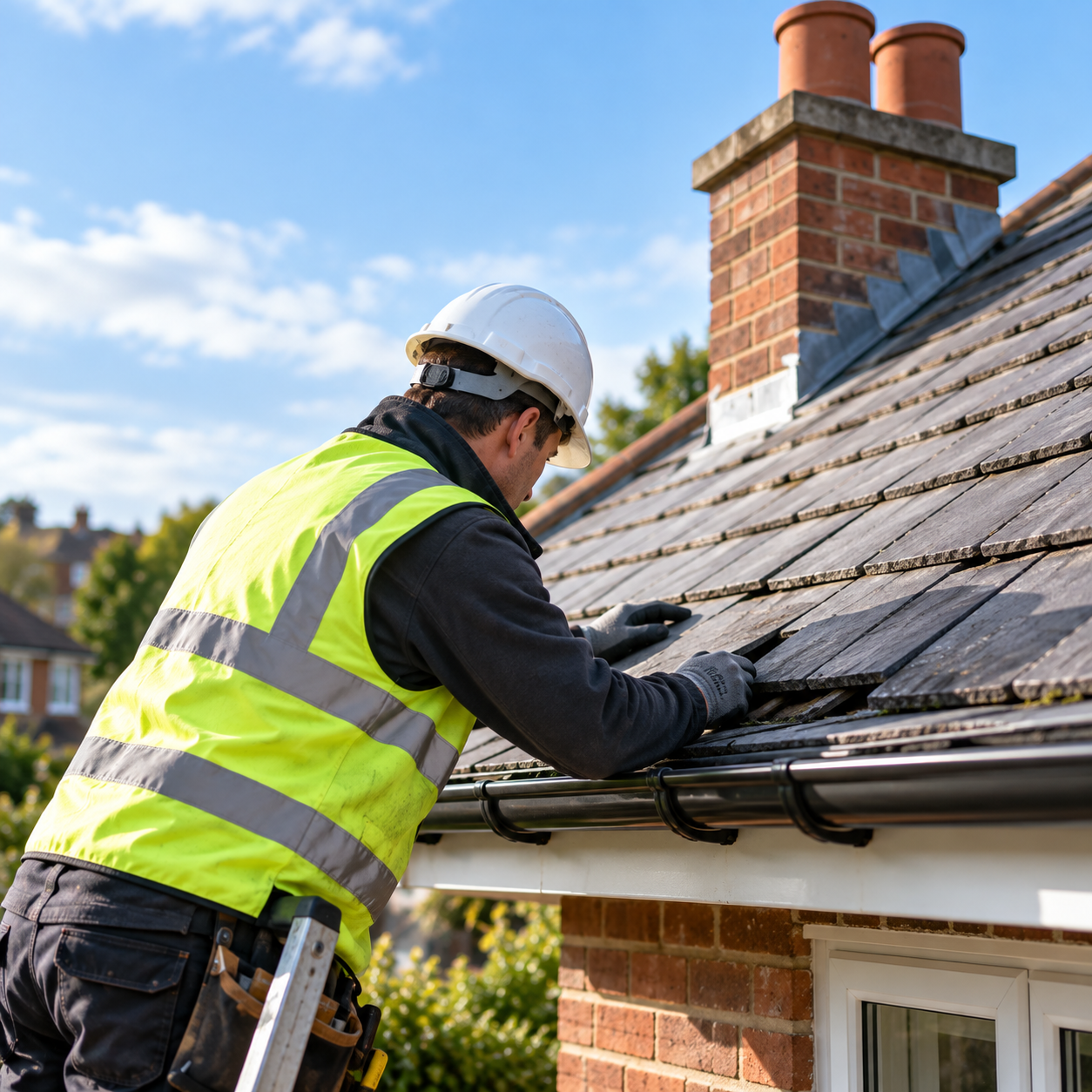
This is why we inspect the full roof before quoting, not just the damaged section: the extent and nature of the proposed work help determine whether Building Regulations apply.
What Is the 25% Rule for Re-Roofing?
Under Building Regulations Approved Document L, a roof is treated as a "thermal element." Approved Document L uses percentage tests when deciding whether work amounts to renovation of a thermal element. The calculations commonly considered include:
- 50% or more of a single roof is being stripped and re-covered, or
- 25% or more of the whole building envelope (roof, walls and floors combined) is renovated on a rolling basis.
If the work is treated as renovation of a thermal element, building control will assess what insulation improvement is technically, functionally and economically feasible. The required construction and notification route depend on the property and the proposed work.
A genuinely minor like-for-like repair may not need an application, but percentage alone does not settle every case. Changes to load, structure, insulation, fire performance, materials or a listed building can still require approval or consent.
Key Facts: When You Need Sign-Off vs When You Don't
| Scenario | Repair or Renovation? | What It Means |
|---|---|---|
| A few storm-damaged tiles or slates, replaced like-for-like | Minor repair — confirm scope | Confirm scope with building control |
| Patching a small area of felt on a flat roof | Minor repair — confirm scope | Confirm scope with building control |
| Re-covering 50%+ of a single roof slope | Renovation — notifiable | Building Notice or Full Plans required |
| Re-covering 25%+ of the whole building envelope | Renovation — notifiable | Insulation upgrade to current standards |
| Replacing decking/boards under a flat roof covering | Renovation — notifiable | Treated as more than a surface repair |
| Increasing roof load (e.g. slate to a heavier tile) | Renovation — notifiable | Structural assessment required |
| Forming a new opening, such as a rooflight | Renovation — notifiable | Structural opening always requires approval |
| Gutters and downpipes | Minor repair — confirm scope | Confirm scope with building control |
Table compiled from gov.uk Building Regulations guidance and Horsham District Council (Sussex Building Control) publications. Always confirm your specific project directly, as officers apply the thresholds with some local discretion.
Building Notice or Full Plans — Which Application Do You Need?
If your job does cross the threshold, there are two routes to approval, and the right one depends on how much certainty you want before work starts.
- Building Notice — the quicker route. No detailed drawings are formally required, and work can start 48 hours after the notice is submitted. Best suited to straightforward re-roofing where the scope is clear.
- Full Plans — you submit detailed drawings before work starts and get formal written approval, valid for three years. The council must decide within five weeks (or longer if you agree to an extension). Better for larger or more complex jobs, or where you want sign-off locked in before committing to a contractor.
How Does Horsham District Council Handle Roofing Applications?
Pulborough, Billingshurst, Storrington and the surrounding villages fall under Horsham District Council, which operates building control as part of Sussex Building Control. Their current guidance says significant roofing work, including some like-for-like replacement, may require approval where structure, insulation or fire performance is affected.
In practice, once you've submitted either a Building Notice or Full Plans application, a Sussex Building Control surveyor will need to inspect the work at agreed stages as it progresses — not just sign off a finished job. If you're unsure which route applies to your project, Horsham District Council's building control team can be contacted directly on 01403 215151 or building.control@horsham.gov.uk before you commit to any work.
Can a Roofer Self-Certify the Work Instead of Involving the Council?
Yes, in most cases. Roofing is one of the few trades with its own dedicated Competent Person Scheme, run by the National Federation of Roofing Contractors (NFRC) under government licence. A registered contractor can self-certify that re-roofing work meets Building Regulations without the homeowner needing to submit anything to the council directly — the contractor notifies building control on your behalf and you receive a compliance certificate.
Without a Competent Person Scheme contractor, you or your roofer apply directly to Horsham District Council via a Building Notice or Full Plans application before work starts, as above.
Do Listed Buildings and Conservation Areas Follow the Same Rules?
The Building Regulations thresholds still apply — Historic England is explicit that listed buildings are not exempt from Building Regulations. But there's a second, separate layer: any repair that changes a listed roof's shape, pitch, covering type or matching materials can also require Listed Building Consent, regardless of the percentage repaired.
Genuinely like-for-like repairs — same material, profile, colour and detailing — are usually treated as maintenance and don't need consent. The moment you swap material, such as natural slate for a synthetic substitute, or an insulation upgrade would visibly alter the roofline, get your local conservation officer involved before work starts. This comes up regularly on the older stone-roofed and listed properties around Petworth and Storrington.
What Happens If You Skip Building Regulations Sign-Off?
If you're not sure which side of the line your job falls on, the safest move is to ask before work starts — either Horsham District Council's building control team or an NFRC Competent Person Scheme roofer can usually confirm it in a couple of minutes.
Before You Start, Check:
- How much of the roof (by area) is actually being re-covered, not just how many tiles feel damaged
- Whether the new covering matches the weight and performance of the original
- Whether the property is listed or in a conservation area
- Whether your roofer is NFRC Competent Person Scheme registered, or whether you'll need to apply to Horsham District Council yourself
Building Regulations Roof Repair FAQs
Do I need Building Regulations approval to fix a few storm-damaged tiles?
Usually not, but the answer depends on the scope and whether structure, insulation or fire performance is affected. Confirm anything beyond a genuinely minor repair with building control before work starts.
What percentage of a roof triggers a Building Regulations application?
Approved Document L uses percentage tests when assessing renovation of thermal elements, but they are not a blanket exemption. Building control should confirm how the rules apply to the proposed work.
Can my roofer self-certify Building Regulations compliance?
Roofers registered with the NFRC Competent Person Scheme can self-certify re-roofing work as compliant, removing the need for you to apply to the council separately.
Do listed buildings need Building Regulations approval for roof repairs?
Yes — listed status doesn't exempt a building from Building Regulations. Repairs that change the roof's material, shape or profile may also need separate Listed Building Consent from the local planning authority.
How long does a Building Notice take with Horsham District Council?
Work can start 48 hours after a Building Notice is submitted to Horsham District Council (Sussex Building Control). A Full Plans application, by comparison, must be decided within five weeks.
What happens if I don't get sign-off for notifiable roof work?
It's an offence under the Building Act 1984, and may lead to an unlimited fine or, for serious offences, imprisonment, and it commonly causes delays or indemnity insurance requirements when you later sell the property.