
What is a fascia board?
In short, a fascia board is the long, straight board fixed to the ends of your rafters, running along the edge of your roof. It's the visible strip running underneath the roof tiles and along the guttering line. Structurally, it closes off the roof timbers from the weather and gives the guttering something solid to be bracketed to — every gutter run depends on a sound fascia behind it. Fascias were traditionally timber, though most UK homes now use low-maintenance uPVC fascia boards, with aluminium and composite options increasingly common on higher-spec or heritage properties.
What is a soffit?
The soffit is the board fitted underneath the fascia, closing the gap between the wall and the roof edge — the underside of the roof overhang. Where the fascia works as a vertical fixing point, the soffit works horizontally, sealing that void against birds, wasps and rot while still allowing air to move. Most modern soffit boards are vented — perforated or fitted with discrete circular vents — specifically so air can pass into the roof void, which matters more than most homeowners realise.
What does guttering do?
Guttering collects rainwater running off the roof and directs it to a downpipe, away from the walls and foundations. Without it, water sheets straight down the brickwork, leading to damp, staining, and eventually structural damage.
Types of guttering
Common UK gutter profiles include:
- Half-round — the traditional, most widely fitted profile
- Square-line / box — a flat-bottomed, higher-capacity profile often used on newer builds
- Ogee — a decorative, angular profile suited to period and character properties
- Deep-flow — increased capacity for larger or steeply pitched roofs
What's the difference between a fascia and a soffit?
Position is the simplest way to tell them apart: the fascia is vertical, facing outward, and carries the guttering. The soffit is horizontal, facing downward, and closes the underside of the eaves. Guttering isn't a board at all — it's the separate rainwater channel fixed to the fascia.
| Component | Position | Main job | Common materials |
|---|---|---|---|
| Fascia | Vertical, roof edge | Seals rafter ends, carries the guttering | uPVC, timber, aluminium, composite |
| Soffit | Horizontal, underside of eaves | Closes the eaves, ventilates the roof void | Vented uPVC, timber, aluminium |
| Guttering | Fixed to the fascia, roof edge | Channels rainwater to the downpipe | uPVC, aluminium, cast iron (period properties) |
Which material is right for your roofline?
uPVC fascia boards are the default choice for most homes — low-maintenance, doesn't need painting, and holds up well against UK weather. Timber suits period and listed properties where matching the original character matters, but needs periodic treatment to stay sound. Aluminium and GRP composite cost more upfront but resist UV fading, impact damage, and warping better than either alternative. If you're weighing up options for your own roofline, our guttering, soffit and fascia repair service page covers pricing factors and typical turnaround in more detail.
A good number of properties across Pulborough, Storrington and the wider West Sussex countryside — particularly those with Horsham stone roofs — still carry original timber fascias and cast iron guttering. Historic England notes that leaking or undersized rainwater goods are a recognised cause of damp in older buildings, and that decorative or traditional rainwater goods can form part of a building's architectural character — so replacement isn't always the right call. We're used to sympathetically repairing or matching these where a like-for-like uPVC swap would look out of place.
Why does soffit ventilation matter?
Vented soffits aren't decorative — they're doing a specific job. Under BS 5250:2021, the British Standard for managing moisture in buildings, a standard cold pitched roof over 15° needs ventilation equivalent to a continuous 10mm opening at the eaves, rising to 25mm on shallower pitches or warm roofs, read alongside Building Regulations Approved Document F. That airflow clears the warm, moist air rising from the house before it condenses on cold roof timbers. Block or seal the soffit vents during a fascia replacement and you can trade a tidy roofline for a damp, rotting loft a few years down the line.
Does guttering have to meet building regulations?
Yes. Rainwater drainage is covered under Approved Document H, Requirement H3 of the Building Regulations for England, which sets out how gutters and downpipes must be sized and positioned so rainwater discharges safely to a soakaway, watercourse or sewer without causing damp to the building. For a more precise calculation, Historic England points to BS EN 12056-3:2000, the design standard for roof drainage based on effective roof area and rainfall intensity. A straightforward like-for-like gutter replacement on an existing home doesn't usually need Building Control sign-off, but the sizing principles still apply — undersized guttering is a common cause of overflow during heavy rain.
If you're already having guttering replaced, it's usually worth getting the fascia and soffit checked at the same time — the access and any scaffolding are already in place, so combining the work often costs less overall than coming back separately for each.
Signs your fascias, soffits or guttering need attention
- Gutters sagging, pulling away from the fascia, or with visibly open joints
- Water overflowing during rain rather than running through the downpipe
- Staining, streaking or green algae marks on the brickwork below the gutter line
- Peeling paint, soft or crumbling timber, or visible rot on the fascia
- Cracked, warped or missing sections of soffit board
- Birds, wasps or vermin nesting behind the soffit
These problems compound quickly. A blocked or leaking gutter overflows onto the brickwork below, which leads to damp masonry and a rotting fascia behind it. Once the fascia has failed, the soffit vents it supports often fail too — cutting off the airflow your roof void depends on and setting up exactly the loft condensation risk covered under BS 5250:2021. What starts as a simple gutter clear can, left long enough, end up as fascia, soffit and roof timber work — see our guide on signs your roof needs repairing for the wider warning signs — instead of a straightforward board swap.
How much does it cost to replace guttering, fascias and soffits?
Pricing depends on a handful of factors rather than a single rate per metre:
- Length of roofline — a single elevation costs less than a full wrap-around replacement
- Material — uPVC is generally the most cost-effective; timber, aluminium and composite cost more
- Extent of damage — a spot repair is cheaper than a full run replacement
- Access — ground-floor properties cost less to access than multi-storey homes needing scaffolding or tower access
- Combined work — bundling fascia, soffit and guttering together in one visit is usually more cost-effective than three separate call-outs, since the access cost is only paid once
The only way to get an accurate figure for your property is a site visit — get a free, no-obligation quote and we'll tell you exactly what's needed and what it costs before any work is booked in. For a general sense of UK market rates before you do, Checkatrade's fascia, soffit and guttering cost guide breaks down typical per-metre pricing by material.
Can you clean your own gutters, or is it best left to a professional?
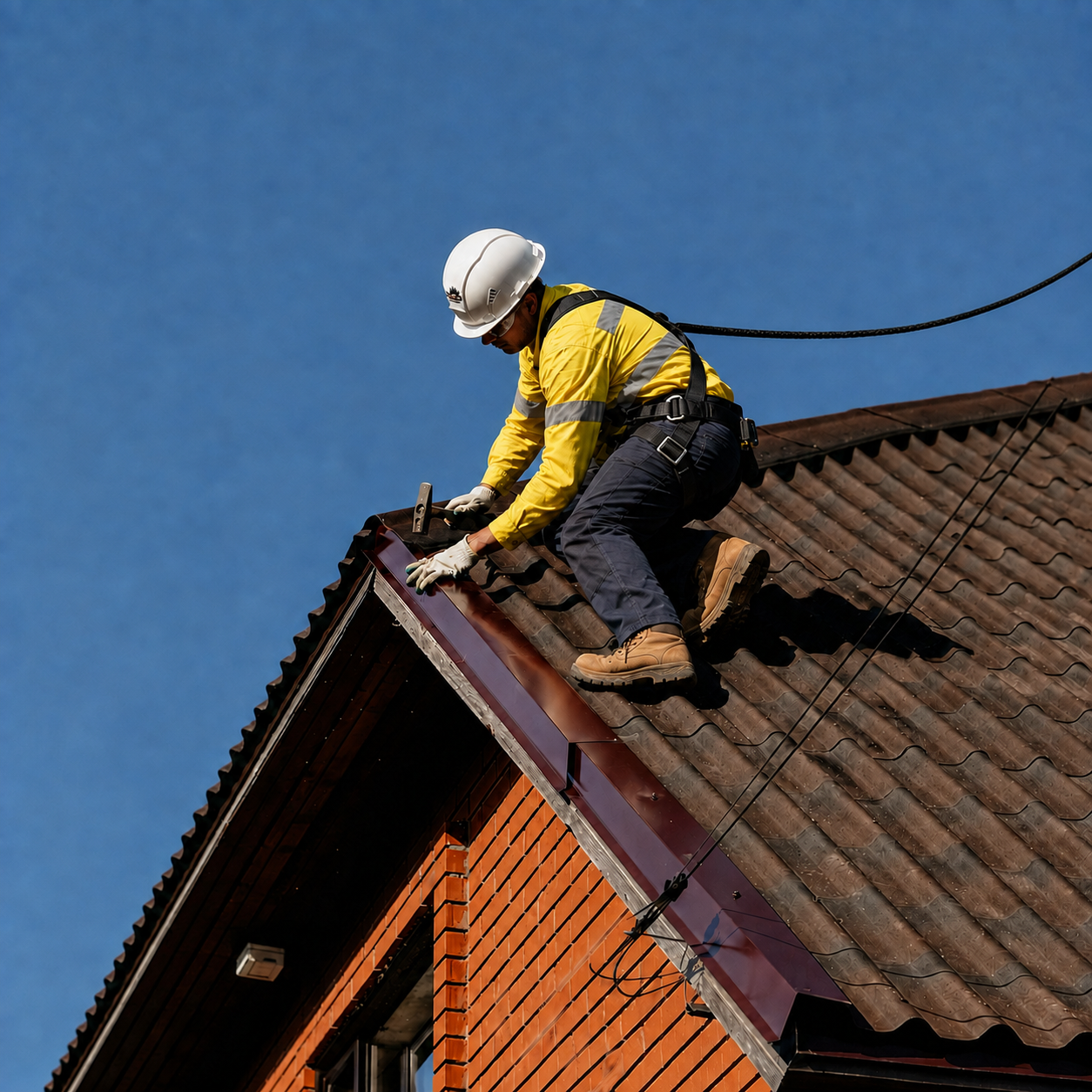
Ground-floor guttering on a bungalow, reached from firm, level ground with a well-footed stepladder, is sometimes manageable yourself. Most UK homes, though, put gutter height well into the territory the HSE's HSG33 guidance on roof work is written for — it specifically covers gutter cleaning and states that gutters should never be used to support a ladder. This work also falls under the Work at Height Regulations 2005, which apply to anyone working above ground level, not just tradespeople.
Roof work accounts for around a quarter of all deaths in the UK construction industry, and a large share of those killed aren't trained roofers but maintenance workers doing exactly this kind of job themselves. Professional access uses proper equipment — tower scaffolding, harness systems or ladder stabilisers — rather than leaning a ladder against the fascia itself.
Seasonal maintenance checklist
Spring
- Clear any debris left over from winter storms
- Check brackets and joints for movement after frost
- Look for peeling paint or soft spots on timber fascias
- Check soffit vents aren't blocked by nests or debris
Autumn
- Clear leaves and debris before winter rain sets in
- Check downpipes run freely with no blockages
- Look for gaps or sagging before winter weight adds strain
- Trim back overhanging branches near the roofline
If your roofline has already taken a hit from bad weather, see our guide on what to do after storm damage.
Frequently asked questions
What's the difference between a fascia and a soffit?
The fascia is the vertical board at the roof edge that carries the guttering. The soffit is the horizontal board underneath it that closes off and ventilates the eaves.
What's the difference between half-round and box guttering?
Half-round guttering has a curved, semi-circular profile and is the traditional choice on most UK homes. Box (or square-line) guttering has a flat bottom and higher capacity, and is more commonly fitted on newer builds with larger roof areas.
How often should gutters be cleaned?
Most roofing contractors recommend clearing gutters at least twice a year — typically autumn, after leaf fall, and again in spring. Properties near overhanging trees may need checking more often.
What causes guttering to sag or pull away from the roof?
The most common causes are a build-up of debris adding weight the brackets weren't designed to carry, corroded or worn fixing brackets, and joint seals failing with age. Left unchecked, sagging guttering puts extra strain on the fascia behind it.
What are fascia boards made from?
uPVC is the most common choice on modern homes. Timber is still used on period and listed properties, and aluminium or composite boards are available where extra durability is wanted.
Can you replace guttering without replacing the fascias?
Yes, if the fascia underneath is sound. If it's already showing rot or damage, most contractors will recommend doing both at once, since the guttering has to come off to access the fascia anyway.
Can fascias and soffits be repaired, or do they need full replacement?
Localised rot or a single cracked section can often be spliced or repaired, particularly on timber. Widespread rot, warping, or multiple failed joints along a run usually make full replacement the more cost-effective option, since patch repairs on an ageing board rarely last.
Does soffit ventilation affect my roof's condition long-term?
Yes. Under BS 5250:2021, roof voids need a minimum level of airflow at the eaves to prevent condensation. Sealing or blocking soffit vents during replacement work is one of the more common causes of loft damp and timber decay we see.
Do you need planning permission to replace fascias, soffits or guttering?
Usually not — like-for-like replacement typically falls under permitted development. Listed buildings and properties in conservation areas can have different rules, particularly around materials and colour, so it's worth checking with your local council first. See our guide on planning permission for roof work for more detail.
How long does fascia and soffit replacement take?
For most semi-detached or terraced homes, fascia and soffit replacement can be completed in a single day. Larger properties, longer roofline runs, or jobs that need scaffolding rather than tower access can take two to three days.